
Thoughtfully applying evidence to the work of schools is both an art and a science. Explore the topics below to brush up on research concepts, consider questions of quality, and strengthen your skills in evidence-based decision making.
Do you have a resource to recommend?
We're always growing this guide with new briefs, toolkits, and fellow clearinghouses that support the use of evidence in education. We'd love to hear from you at info@evidenceforpa.org.
Explore by topic:
ESSA Tiers
For Pennsylvania schools, ESSA's four tiers of evidence are defined:
in part by the law itself, and
in part by the Pennsylvania Department of Education, drawing on non-regulatory guidance from the U.S. Department of Education [PDF].
The ESSA tiers are designed to hold educational evidence to a high standard, so we can have confidence in the programs we choose.
ESSA Tiers at a Glance
Take a look at the ESSA Tiers side-by-side to understand their differences:
The ESSA Tiers Are :
Confidence Builders
Every facet of the ESSA Tiers are designed to indicate how confident you can be in the evidence. The higher the tier, the greater the confidence that it was strategy that made the difference, and not some other factor.
Focused on Outcomes
An ESSA tier is assigned to an outcome, not a whole strategy. One strategy might have research with outcomes at all four levels of evidence – it's up to you to decide if the outcome you're seeking has been demonstrated at a standard you can have confidence in, with students that are similar to yours.
Leaving Room for Innovation
Tier 4 allows for lesser-known, less-studied, often innovative interventions to get the consideration they deserve, while ensuring that we conduct ongoing research and don't use an ineffective program for long.
The ESSA Tiers are Not :
A measure of results.
A higher-tier strategy is not necessarily more effective than a lower-tier strategy. This is because ESSA tiers reflect, in part, the rigor of the methods used to study the strategy.
A measure of goodness of fit.
A higher tier assignment does not mean the strategy is better for your school. A Tier 3 outcome for a strategy that fits your budget, resources, timeline, and desired impact might be better for you than a Tier 1 outcome for a strategy that exceeds your capacity or doesn't serve the students you're hoping to serve.
About compliance.
It is important to remember that evidence isn’t about checking boxes, but about having the information you need to make a great decision. Once you experience the confidence of grounding decisions in great evidence, you'll want to promote a culture of evidence for all decisions, big and small.
Preparing for Tier 4
Tier 4 is sometimes referred to as the “Innovation Sphere” – a place for strategies that have the potential to improve outcomes, but don’t yet have evidence rigorous enough to meet ESSA Tier 1-3 requirements. What should you know if you're considering implementing a strategy with evidence rated at Tier 4?
Is there a well-specified logic model?
For a strategy’s evidence to qualify for ESSA Tier IV, it must have a well-specified logic model that builds on research suggesting how the strategy will improve an outcome. Logic models, which are typically represented graphically, show the components of the strategy and how they are connected to expected outcomes. Logic models for Tier IV must specify the research that informs the strategy.Learn More: Logic Models [PDF]How will you monitor your results?
Although there can be big rewards from taking risks on new and innovative strategies, you’ll want to measure and monitor progress. Your plan can include both implementation measures (is the strategy being offered as intended?) and short-term and long-term outcomes (are we meeting our targets on related outcomes?).Will your school study the strategy’s effectiveness?
One of the conditions of a Tier 4 rating is that there is a current or planned evaluation of the strategy’s effectiveness for improving outcomes. The goal is to develop more rigorous evidence (Tier 3 or stronger) about the strategy than what is currently available. This evaluation can be conducted in your school or elsewhere. Even if you know of a study happening in another place, why not consider tracking your local data, to learn about the impact of the strategy in your school? You could also consider teaming up with other schools to study how the strategy works in different contexts.
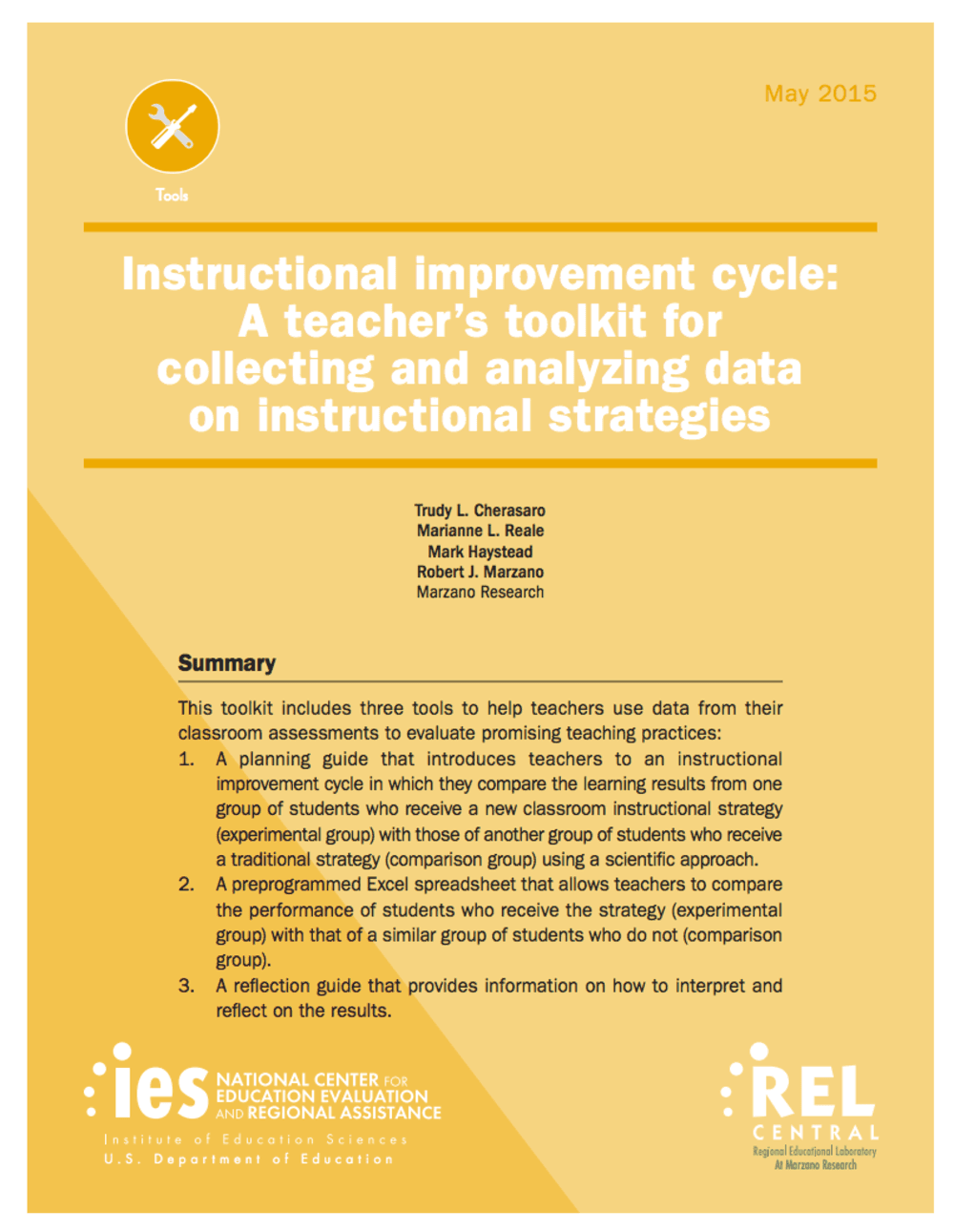
The Regional Education Laboratory (REL) has published A teacher’s toolkit for collecting and analyzing data on instructional strategies, a guide and accompanying Microsoft Excel® file helps schools collect and analyze data on an intervention. The presence of a plan in your school to study an outcome can qualify it for a Tier 4 rating.
Planning to study an intervention?
If your school will be implementing a strategy and collecting data, or if you're a researcher pursuing high quality evidence in a school setting, we want to know about it! We would love to hear from you at info@evidenceforpa.org.