
Learn with Us
Get to know ESSA
The Every Student Succeeds Act (ESSA)
On December 10, 2015, President Barack Obama signed the Every Student Succeeds Act (ESSA), which reauthorizes the Elementary and Secondary Education Act (ESEA) of 1965. Developed and passed with strong, bipartisan support, ESSA replaced No Child Left Behind (NCLB) as the nation's main education law.
ESSA advances ESEA’s promise of ensuring that all students – from pre-kindergarten to postsecondary, including low-income students, students of color, students with disabilities, English Learners, and other historically marginalized students – have access to a world-class education that prepares them for college, career, and life.
- USDOE: The Every Student Succeeds Act (ESSA)
- USDOE: Non-Regulatory Guidance: Using Evidence to Strengthen Education Investments [PDF]
ESSA in Pennsylvania
ESSA provides state education agencies with new flexibility in determining how and when to deliver school improvement strategies. This flexibility presents an historic opportunity to chart a new course for school improvement in Pennsylvania: continuing to transition education policy away from a strict focus on compliance, and toward the establishment of rigorous expectations for students, and collaboration and assistance for all schools to help them meet this standard.
Using, generating, and sharing evidence about effective strategies to support students gives stakeholders an important tool to accelerate student learning.US Department of EducationNon-Regulatory Guidance: Using Evidence to Strengthen Education Investments (2016)
Presenting Evidence with the Evidence Resource Center
This Evidence Resource Center (ERC) is part of a suite of tools that the Pennsylvania Department of Education has developed to support continuous improvement of teaching and learning in Pennsylvania. The PA ERC aims to share strategies and interventions that have the potential to positively impact student outcomes. We do this by locating, curating, and summarizing studies that meet ESSA’s evidence requirements and their relevant outcomes and required resources for implementation.
“Interventions supported by higher levels of evidence are more likely to improve student outcomes because they have been proven to be effective.”
“The relevance of the evidence – specifically the setting (e.g., elementary school) and/or population (e.g., students with disabilities, English Learners) of the evidence – may predict how well an evidence-based intervention will work in a local context. LEAs and schools should look for interventions supported by strong evidence or moderate evidence in a similar setting and/or population to the ones being served.”
“The available funding, staff resources, staff skills, and support for interventions should also be considered when selecting an evidence-based intervention.”
- US Department of Education Non-Regulatory Guidance: Using Evidence to Strengthen Education Investments (2016)
The ESSA Tiers of Evidence
ESSA outlines four tiers of evidence to help school leaders and educators evaluate the best evidence and make better decisions. Evidence can reach one of four Tiers of quality, as defined by ESSA:
WHAT IS AN “EVIDENCE-BASED” INTERVENTION?(from section 8101(21)(A) of the ESEA)
“…the term ‘evidence-based,’ when used with respect to a State, local educational agency, or school activity, means an activity, strategy, or intervention that –
- demonstrates a statistically significant effect on improving student outcomes or other relevant outcomes based on –
- strong evidence from at least one well-designed and well-implemented experimental study;
- moderate evidence from at least one well-designed and well-implemented quasi-experimental study; or
- promising evidence from at least one well-designed and well-implemented correlational study with statistical controls for selection bias; or
- demonstrates a rationale based on high-quality research findings or positive evaluation that such activity, strategy, or intervention is likely to improve student outcomes or other relevant outcomes; and
- includes ongoing efforts to examine the effects of such activity, strategy, or intervention.
Evidence reaches ESSA Tier 1, 2, 3 or 4 according to how well its outcomes have beenstudied rather than just how well they were achieved. Study methods like randomization, controlling for statistical bias, attrition, and even sample size can impact how likely it is that an outcome can be replicated in your school. Tier 1 evidence has been proven by the highest quality study methods; Tier 4 evidence demonstrates a rationale, but does not yet strongly prove effectiveness. In this way, ESSA Tiers reinforce the idea that a high-quality study leads to trustworthy outcomes.
Studies for the ERC are selected using a set of research protocols influenced by those in use by the What Works Clearinghouse (WWC)and with guidance from American Institutes for Research (AIR). A research team comprised of current and former educators, principals, superintendents, and school board members reviews and summarizes studies, evaluating them against ESSA criteria to suggest Tiers for relevant outcomes.
However, the ERC only offers suggested ESSA Tiers. A Tier must be verified by an individual school based on similarity of setting and population, and even Tier 4 evidence relies on further study (perhaps within your school). See below for specific tips on navigating the Evidence Tiers.
ERC Methods and Protocols

Explore ERC Research Protocols by category
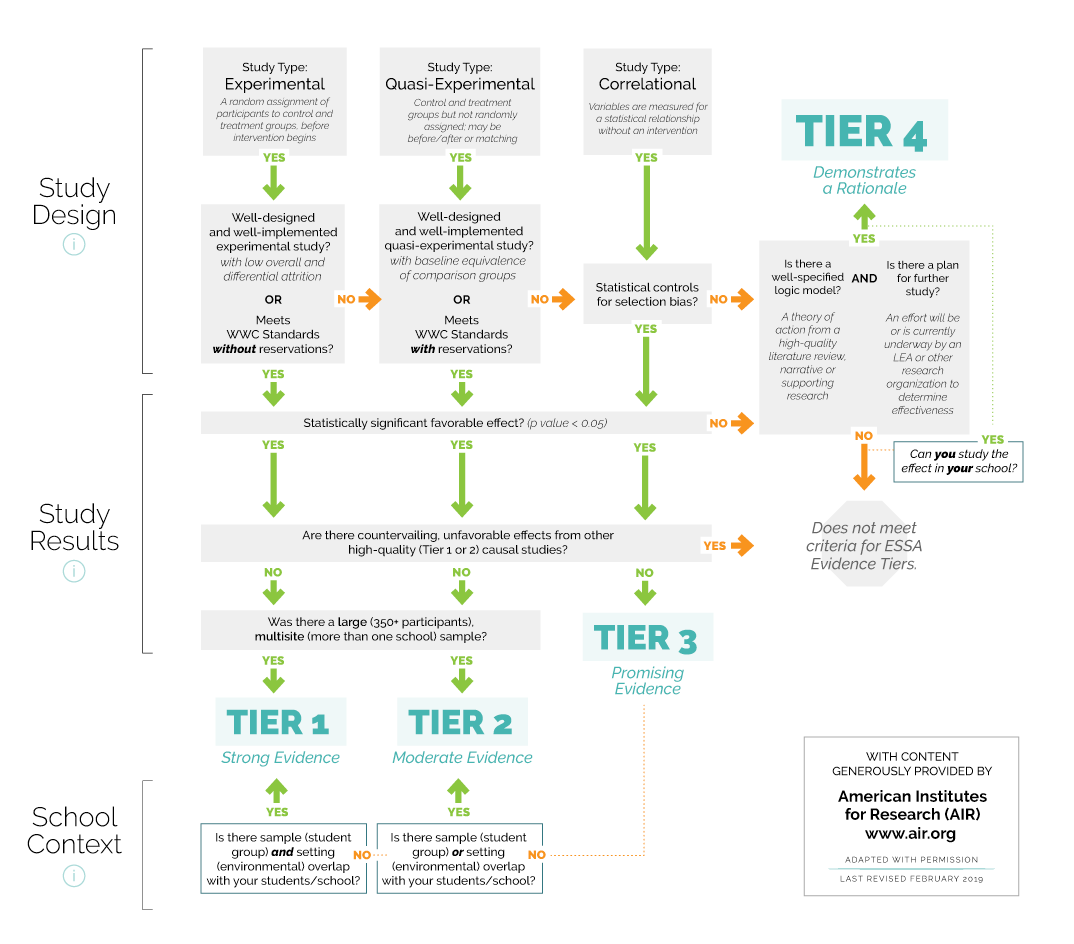
Explore the ESSA Tier Decision-Making Flowchart (adapted with permission from American Institutes for Research)

Tips for Navigating the ESSA Tiers
Always focus on your desired outcomes.Within one study, a researcher's evidence of one outcome (such as "Vocabulary skills") may be Tier 1 evidence, but other outcomes (such as "Alphabetics") may be only Tier 2 or Tier 3 evidence. School leaders should consider the nature of their school's challenges and select interventions that directly impact the specific outcome they're seeking, at an ESSA Tier that works for their needs.
Verify the Tier.As much as we would like to assign firm ESSA Tiers to all outcomes in our clearinghouse, our certainty stops at the edge of your school district. The last step of ESSA Tier determination resides with the school or school district where the intervention will be used. Similarity of setting and sample are critical factors in determining a strategy's goodness of fit. That's why we suggest an ESSA Tier, but encourage school leaders to confirm a Tier 1 or 2 rating by comparing the participants studied to their own school and community setting. For more details on this, see our ESSA Tier Decision-Making Flowchart [PNG].
Tier 4 Might Need Your Help.One of the conditions of a Tier 4 rating is that there is a plan currently or soon-to-be underway to further study the strategy. However, it will be a challenge knowing about and keeping up with pending or in-progress studies. How will you know that a school is studying an effort? The great news is that your school can be that school. The Regional Education Laboratory (REL) has published A teacher’s toolkit for collecting and analyzing data on instructional strategies, a fantastic guide and accompanying Microsoft Excel® file that is set up to help schools collect and analyze data on an intervention. The presence of a plan in your school to study an intervention can qualify it for a Tier 4 rating.
Planning to study an intervention?
If your school will be implementing a strategy and collecting data, or if you're a researcher pursuing high quality evidence in a school setting, we want to know about it! We would love to hear from you at info@evidenceforpa.org.
Didn't find what you were looking for?
The ERC is not a comprehensive or exclusive list of strategies available to local education agencies and schools in Pennsylvania. Many research organizations and other state departments of education are producing similar resource lists and collections, such as:
- What Works Clearinghouse
- Evidence for ESSA
- Social Programs That Work (Formerly Top Tier Evidence)
- Blueprints for Healthy Youth Development
- Results First Clearinghouse
- National Dropout Prevention Center
- National Center for Systemic Improvement
- National Center for School Leadership
- IDEAs that Work
- Collaboration for Effective Educator Development
- Center on Instruction
- Synthesis of Information on Evidence-Based Practices for School Improvement: 20 Studies and tools Focused on Evidence-Based Practices in School Improvement [PDF]
- CAST: Universal Design for Learning
- Achieve
- National Institute for Direct Instruction
- University of Kansas Direct Instruction
- National Center on Improving Literacy
- Reading Rockets
- Word Generation
- Florida Center for Reading Research
- The Reading League
- RAND: Education and Literacy
- Writing Next [PDF]
- Collaborative Strategic Reading
- Literacy How
- US Department of Education
- American Psychological Association
- Evidence-Based Intervention Network
- Strategic Education Research Partnerships
- Achieve the Core
- WIDA
- Effective Literacy and English Language Instruction for English Learners in the Elementary Grades
- National Instructional Materials Access Center
- National Technical Assistance Center on Transition
- RENEW
- National Center for School Engagement
- SAMHSA Evidence-Based Practices Resource Center
- Attendance Works
- CASEL
- National Center on Intensive Intervention
- Consortium on Reading Excellence in Education
- RTI Action Network
- National Clearinghouse for English Language Acquisition Nexus